
Why Carrier Size Matters More Than You Think
A carrier that is too small leaves your pet cramped, stressed, and overheated. One that is too big lets them slide around with every step, which is just as uncomfortable — and it throws your own balance off, too.
The good news is that sizing a carrier is not guesswork. With a tape measure, your bathroom scale, and five minutes of your time, you can pick a carrier your pet will enjoy riding in.
Step 1: Weigh Your Pet First
Every carrier has a weight limit, and it is the first number to check. Weigh your pet before you shop — do not rely on a guess from your last vet visit, because a few pounds make a real difference at this scale.
The easiest way to weigh a cat or small dog at home is the hold-and-subtract method: step on the bathroom scale holding your pet, note the number, then weigh yourself alone and subtract. If your pet is close to a carrier’s stated limit, size up — a carrier loaded to its maximum is harder on the straps, the zippers, and your shoulders.
Weight alone is not enough, though. A long, lean cat can weigh the same as a short, stocky dog and need a completely different carrier shape.
Step 2: Measure Length, Height, and Chest
Grab a soft measuring tape and a few treats to keep your pet still. Take three measurements while your pet is standing naturally:
- Length: from the base of the neck to the base of the tail. This is the most important measurement — it decides whether your pet can lie down comfortably.
- Height: from the floor to the top of the shoulders (not the head). This tells you whether your pet can sit upright without crouching.
- Chest girth: around the widest part of the chest, just behind the front legs. This tells you whether your pet can turn around inside.
Compare these numbers with the carrier’s interior dimensions, not its exterior ones — thick padding and a sturdy base eat into the space your pet actually gets. Add roughly 2 inches (5 cm) of breathing room to each measurement.
Step 3: Use the Sit-and-Turn Test
Here is the golden rule of carrier sizing: your pet should be able to sit, stand, lie down, and turn around inside the carrier. If they can do all four, the size is right. If they can only do two or three, it is too small.
This is not just about comfort. A pet that cannot turn around cannot shift position on a long outing, which leads to stiff joints and stress. When you first try a carrier at home, let your pet climb in on their own, offer a treat, and watch: a relaxed pet will circle once and settle down. A pet that freezes or scrambles is telling you something.
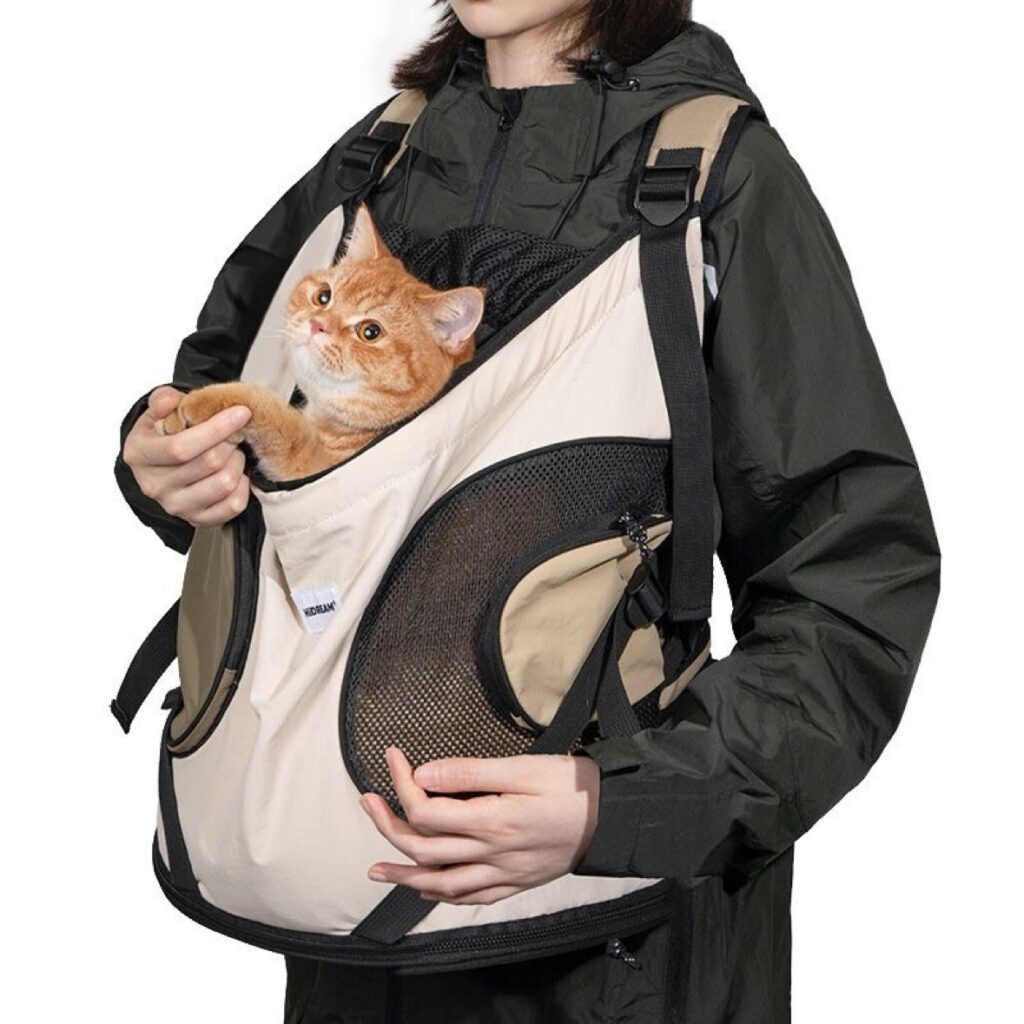
Our Pet Front Carrier Backpack for Cats & Small Dogs ($39.99) is built around exactly this test — its sturdy cushioned base gives your pet a solid floor to stand and turn on, instead of a sagging fabric bottom. The product page spells out the fit check: your pet should be able to sit and turn around inside, with the straps adjusted so the carrier sits snug against your chest.
Step 4: Match the Carrier to Your Body, Too
Size is not only about your pet. You are the one carrying the load, so the carrier has to fit you as well. Wide, padded straps spread the weight, and X-shaped straps — like the ones on our front carrier — distribute the load across your shoulders, waist, and back instead of hanging it all from your neck. Look for straps you can tighten easily with one hand: a carrier that sits snug against your chest bounces less and feels lighter than one that swings.
Step 5: Cats and Dogs Need Different Things
Cats and small dogs may share a carrier category, but their sizing needs are not identical. Cats usually want enclosure: most feel safer in a snug, den-like space with mesh panels they can see through, and too much empty space makes an anxious cat feel exposed rather than free. Small dogs, on the other hand, often want a view — many like to sit up and look out, so headroom and a wide opening matter more than a cozy fit.
Anxious pets of either species do better in a front-facing carrier they can see you from. If you share one carrier between a cat and a dog, size it for the larger of the two, and add a familiar-smelling blanket for the cat so the bigger space still feels like a den.
Common Sizing Mistakes to Avoid
Trusting the size label alone. “Small” means something different to every brand. Always check the actual interior measurements and weight limit for the specific model.
Skipping the at-home trial. Never make the first trip a long one. Let your pet explore the carrier at home for a few days first, with the door open and treats inside. A pet that has already napped in the carrier will handle a real outing far better. And once you have the right carrier, keep it fresh: our guide to cleaning a dog carrier backpack walks through exactly how to wash it without damaging the straps or padding.
What If You Are Between Sizes?
If your pet falls between two sizes, the answer depends on how they travel. For short trips around the neighborhood, the smaller size is usually fine and easier for you to carry. For longer outings or vet visits, go with the larger size. If you fly with your pet, check the airline’s under-seat dimensions first, because the airline’s limit overrides everything else. Our carry-on carrier tips for flying with a small dog explain how to measure for that situation.
Frequently Asked Questions
How do I know if a carrier backpack is too small for my cat?
Use the sit-and-turn test. If your cat cannot sit upright, turn around, or lie down without pressing against the sides, the carrier is too small.
Can one carrier work for both a cat and a small dog?
Yes, as long as it fits the larger pet. Size it for the bigger pet, and let each animal try it at home first.
Should a carrier be snug or roomy?
Snug, but not tight. Your pet should be able to move and turn, with a couple of inches to spare in every direction. A carrier that is too roomy lets your pet slide around and makes the load harder for you to balance.
The Bottom Line
Choosing the right size comes down to three numbers — your pet’s weight, length, and height — plus one simple test: can they sit, stand, lie down, and turn around inside? Get those right, and both of you will enjoy the outing a lot more.
Ready to find your fit? Our Pet Front Carrier Backpack ($39.99) is designed for cats and small dogs, with a cushioned base, breathable mesh, and adjustable X-shaped straps — and you can browse our cat collection for more carriers, toys, and everyday essentials.